


Opinion article - Why is a good book a lifelong gift for a child?
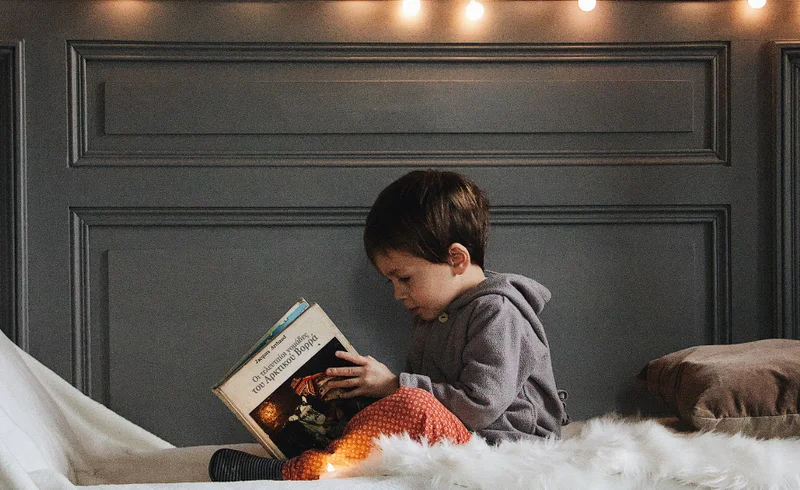
Between artificial intelligence, easy reading, and a constant flood of stimuli, high-quality children’s literature remains a foundation for children’s thinking, language, and inner world.
By Anastasia Koumoula, Child Psychiatrist and Director of the Child & Adolescent Mental Health Initiative.
Why should I buy my child a good book? Why should I encourage them to read it? This question came to mind after reading two posts on social media during the holiday season.
The first was by Yuval Noah Harari, who wrote that there is a 50% chance his next book will be his last, as he can no longer compete with artificial intelligence (AI).
The second was by author Eva Stamou, about low-quality fiction and how it could be seen as a “barbiturate for thought.”
Indeed, artificial intelligence now seems capable of producing flawless texts: with correct spelling, proper syntax, and cohesion. Most of us already use it to edit, improve, or translate our own ideas—when, of course, we have something to say. Even book editing now seems, to a large extent, to pass through AI applications.
But can AI produce ideas with personal imprint? Can it generate theory, express lived experience, or capture the complexity of human emotion?
AI can combine concepts, detect patterns, and propose interpretations. But these do not arise from conflict, existential questioning, or lived experience—not at least in its current state. It often provides ready-made, easy answers. It imitates experience, but it has no body that feels pain, no anxiety, loss, or dead ends.
We hope Harari did not mean it literally, but rather as a warning.
So, is the book in danger due to technology? And do people still read books today?
It is a fact that our daily lives are dominated by technology—both at work and in leisure. Continuous scrolling and rapid topic switching (a recipe, a scientific article, an ad, a book review, a holiday photo from a friend) offer constant small dopamine hits that keep the brain in a state of ongoing search.
Thus, our brain is trained for fragmented, short-term attention. The book, on the other hand, requires genuine concentration and prolonged, active attention.
But does it matter what one reads?
Eva Stamou cites a study by the Hellenic Copyright Organization (OSDEL), according to which almost all fiction books chosen by adults in 2023–2024 fall into the category of low-quality commercial fiction.
This low-quality literature offers immediate pleasure, relaxation, and psychological relief—“with a romance novel I forget,” as an old advertisement once said. And that is precisely the goal: not to provoke thought, not to stir uncomfortable emotions, to offer the fantasy of well-being in an idealized world without real conflicts. Everything is easy, difficulties are quickly resolved, and the ending is almost always happy.
So what is the value of a good literary book?
A good literary book cultivates thinking. It does not offer ready-made answers. It weaves experience into language, uses refined and multi-layered expressions to convey lived experience. It avoids clichés and creates new ways of saying things. It departs from the flat realism of everyday language, employing metaphor, implication, and ambiguity. It can transport us to other worlds, cultures, and historical periods.
And what does this mean for children?
A good book provides children with a rich vocabulary to describe thoughts and feelings. It introduces complex words and linguistic structures that give shape to their inner experiences. Language directly affects thinking: the richer the language, the more complex thinking becomes. The development of language contributes to cognitive maturity.
That is why children need exposure to books and stories from a very early age. Aesop’s fables are a characteristic example of the developmental transition from literal to symbolic: animals represent human attitudes and behaviors. The moral is not given ready-made, but invites the child to think. The fable of the grasshopper and the ant, for instance, introduces concepts such as industriousness and foresight, without didacticism.
Is there such a thing as low-quality children’s literature?
Certainly. Not all books are good. There are children’s books aimed exclusively at stimulation through fast-paced action and constant sensory input, books with simplistic, moralizing messages (“you must…”, “the right thing is…”), stereotypical characters, and predictable plots. Such books do not help the child develop thinking, recognize complex emotions, or evolve psychologically.
Parents need to choose books carefully—not because a low-quality book will “harm” the child, but because a good book can help build a richer inner world.
In a world of speed and constant stimulation, a good children’s book is not a luxury but a necessity. It does not compete with technology; it offers depth, time, and space for thought. Choosing a good book for a child is an investment in language, in thinking, and in their inner world—an investment that accompanies them throughout their life.