


Child and Adolescent Mental Health in Volos: CAMHI Holds Successful Open Event
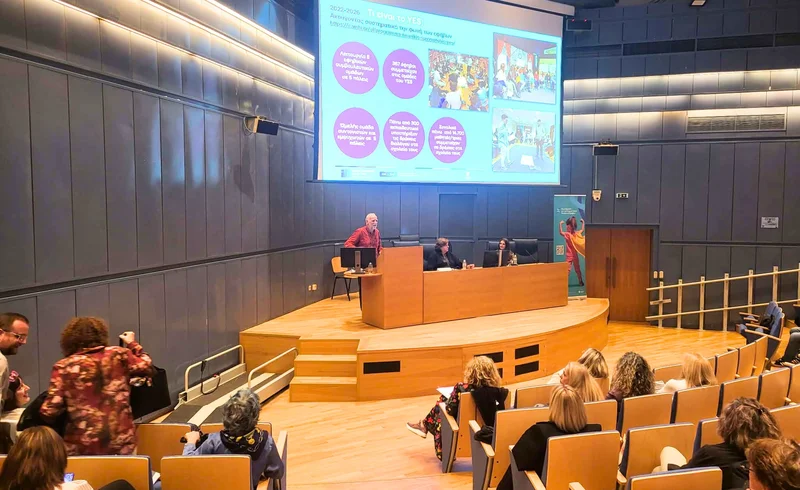
On Saturday, 17 October 2026, the Child & Adolescent Mental Health Initiative (CAMHI) held an open event in Volos, at the Ioannis Kordatos Amphitheatre of the University of Thessaly, with the participation of teachers, doctors and mental health professionals from the area. The event highlighted the local community's needs and CAMHI’s role in strengthening frontline professionals' skills, presenting its free training programmes for teachers, doctors and mental health professionals. Particular emphasis was placed on prevention and intervention, and on connecting schools, families and professionals, both essential for recognising children’s needs early and ensuring they can access appropriate support.
The event was supported by the Department of Special Education and the Postgraduate Programmes “Educational Sciences: Special Education” and “Counselling Psychology and Counselling in Special Education, Education and Health”.
Welcome addresses
Christos Venetis, President of the Medical Association of Magnesia, and Giannis Anastasiou, Deputy Regional Governor on behalf of the Region of Thessaly, opened the event. Speaking for the University of Thessaly, Chryssi Laspidou, Vice Rector for Research, Innovation, Digital Governance and Lifelong Learning, said: “The voices of children and adolescents themselves must be at the heart of every effort concerning their mental health. Investing in children’s mental health is an investment in the future of our society, and the University of Thessaly will continue to contribute actively to this effort.”
On behalf of the Regional Directorate of Primary and Secondary Education, Dr Artemis Papadimitriou, Regional Education Quality Supervisor for Thessaly, stated: “I believe today’s conference is an important opportunity to exchange experience and knowledge, to highlight the daily challenges faced by children and adolescents, and to explore together how the education system can contribute even more effectively to the prevention and promotion of mental health.”
What the Initiative presented
CAMHI members presented its training programmes, which are implemented with the support of the Ministry of Health and the Ministry of Education, Religious Affairs and Sports:
- the Basic Training Programme “Mental Health Literacy for Children & Adolescents”, for teachers and members of the Special Educational Support Staff,
- the Programme “Screening for Mental Health Problems in Children & Adolescents”, for paediatricians, general/family doctors and rural doctors,
- and the Advanced Training Programme for mental health professionals.
CAMHI and its programmes were presented by Evangelini (Lilian) Athanasopoulou, Child & Adolescent Psychiatrist and member of the Scientific Coordinating Committee; Nikos Zilikis, Professor Emeritus of Child and Adolescent Psychiatry at the Aristotle University of Thessaloniki and member of the Scientific Coordinating Committee; and Despina Kioteoglou, a CAMHI Psychologist. Giorgos Moschos, Director of the YES Youth Engagement Scheme, presented the School Dialogue Activities and the Active Schools Network.
What local professionals in Magnesia are reporting
The discussion, titled “Everyday Mental Health Challenges of Children & Adolescents in Thessaly: The Perspective of Local Professionals Working with Children”, featured:
- Christina I. Rousi-Vergou, Assistant Professor of Educational Psychology at the University of Thessaly,
- Paraskevi Tsipropoulou, Psychologist Training Advisor for Thessaly, the Regional Units of Evrytania and Fthiotida,
- Dimitra Chatzi, Deputy Head of the Centre for Interdisciplinary Assessment, Counselling and Support (KEDASY) of Magnesia,
- child psychiatrist Maria Chatzieleftheriou,
- and paediatrician Anna Psyrropoulou, Director at the National Health System (ESY) and the General Hospital of Volos “Achillopoulio”.
The professionals described needs that are growing and becoming more complex. Among younger children, anxiety appears as early as nine or ten years old, showing up as panic attacks and physical symptoms. In adolescents, depression often hides behind anger and aggression, while cases of school bullying, school refusal and eating disorders are on the rise. Screen addiction now begins in infancy. The speakers linked these developments to the aftermath of the pandemic and the economic crisis, as well as to the shrinking of public services.
School emerged as a key setting for prevention and early intervention, since teachers are alongside children every day and are well placed to spot the signs early. The speakers noted that experiential, classroom-based activities that draw on physical expression and children’s active participation get the best response in prevention work. The panel also stressed the importance of a stable point of reference at school, someone children can turn to with trust. Another need highlighted was a psychologist and a social worker in every school, along with stronger Educational Support Teams.
Public services in the area continue to face serious challenges in staffing and availability. Child psychiatric care and the management of abuse cases need the most support, and adequate training and backing for professionals remain critical in both.
The speakers agreed that the answer lies in cooperation. Schools, families, KEDASY, hospitals and mental health services need a stable network, with clear roles, a common language and defined referral pathways, so that every professional knows where and how to seek help. They also gave central importance to working with parents, since fear of stigma in small towns and limited awareness make it hard for many families to recognise and accept that their child needs support.
Finally, the speakers underlined the value of the legacy left by the CAMHI programmes and expressed the hope that they will continue and be integrated into the public health and education systems.
The event closed with questions and discussion with the audience, followed by a networking reception.